Does Gluco Cleanse Tea Work? The Plants Have Trials, the Product Has None
We searched Europe PMC for the product and for the mechanism the seller leads with. Both searches came back empty. The plants themselves are a different story.
Checked 29 September 2026. Label and price figures checked 29 September 2026. Every source is named below, so you can repeat each check yourself.
Does Gluco Cleanse Tea have any study behind its claim?
What the published record holds on the tea, and on its central mechanism
Does Gluco Cleanse Tea work? No study of the tea exists. Some of the tea's plants show real but mixed effects in trials. The seller publishes no dose for any plant, so nobody can check a studied amount.
We searched Europe PMC on 29 September 2026. Two results decide this page.
Zero records for the product. A search for "gluco cleanse tea" returned 0 records. We also searched "all day slimming tea", the product named in the seller's page footer. That returned 0 too.
Zero trials for the mechanism. The seller's central claim is that the tea "Reignites Your Pancreas, Allowing It To Produce Insulin As It Did When You Were Young". Its first ingredient entry says gymnema "Helps regenerate insulin-producing beta cells in your pancreas."
We searched gymnema sylvestre, beta cell, and human or patients, limited to randomized controlled trials. The search returned 0 records. No published randomized human trial supports beta-cell regeneration by gymnema.
Those are the seller's claims. We report them and we don't repeat them as fact. The page also says the tea is "proven to support healthy blood sugar level and fix type 2 diabetes". No published study of the tea sits behind the word proven.
The page ends with a list headed "Scientific References". It has 29 entries. Every one is a general consumer page about type 2 diabetes. Sources include Mayo Clinic, WebMD and the Cleveland Clinic. None studies the tea. None studies an ingredient. None mentions the product.
The same page carries an FDA statement: "This product is not intended to diagnose, treat, cure or prevent any disease." So it claims to fix a disease and says it doesn't treat one.
What have trials on the tea's plants found?
The evidence for the plants is real and mixed
The plants aren't fake. Some have been tested in people. Here's what the trials we found report, with PubMed IDs so you can read them.
Cinnamon, Cochrane, 2012. Trials gave "a mean dose of 2 g daily, for a period ranging from 4 to 16 weeks" (PMID 22972104). The review's finding: "The effect of cinnamon on fasting blood glucose level was inconclusive. No statistically significant difference in glycosylated haemoglobin A1c (HbA1c), serum insulin or postprandial glucose was found between cinnamon and control groups."
Cinnamon, Allen et al., 2013. A meta-analysis of 10 trials and 543 patients. Doses ran from 120 mg to 6 g a day, for 4 to 18 weeks. Fasting plasma glucose fell 24.59 mg/dL (PMID 24019277). The two reviews of the same spice disagree on fasting glucose.
Fenugreek, 2024. A Heliyon meta-analysis found fasting glucose fell 20.32 mg/dL. HbA1c fell 0.54 percentage points (PMID 39286181). HbA1c is the measure that tracks diabetes control over time.
Fenugreek, 2025. A second review found fasting glucose fell 16.75 mg/dL. The effect on insulin resistance wasn't significant (PMID 41509111).
Bitter melon, 2024. A Heliyon meta-analysis reported "significant reductions in fasting blood glucose (FBG) and glycosylated hemoglobin A1c (HbA1c)" in people with type 2 diabetes (PMID 38784554).
| Plant | Source | What it found |
|---|---|---|
| Cinnamon | Cochrane 2012, PMID 22972104 | Fasting glucose inconclusive. No significant HbA1c change. |
| Cinnamon | Allen 2013, PMID 24019277 | Fasting glucose down 24.59 mg/dL. |
| Fenugreek | Heliyon 2024, PMID 39286181 | Fasting glucose down 20.32 mg/dL. HbA1c down 0.54 points. |
| Fenugreek | Avicenna 2025, PMID 41509111 | Fasting glucose down 16.75 mg/dL. Insulin resistance not significant. |
| Bitter melon | Heliyon 2024, PMID 38784554 | Significant drops in fasting glucose and HbA1c. |
| Gymnema | Search for beta-cell trials in humans | 0 records. |
These are real findings. They're findings about those plants in trials. They aren't findings about this tea.
Fenugreek and bitter melon both lowered fasting glucose in the reviews above. Cinnamon is split. Gymnema, the seller's lead ingredient, has 17 randomized trials on record and none on its headline claim. The ingredients page has the count for all 19.
The dose arithmetic: trials against a teabag
Why a trial result can't be carried into a cup of this tea
Dose decides whether a trial says anything about a product. Cochrane's cinnamon trials used a mean of 2 g of cinnamon a day, on its own.
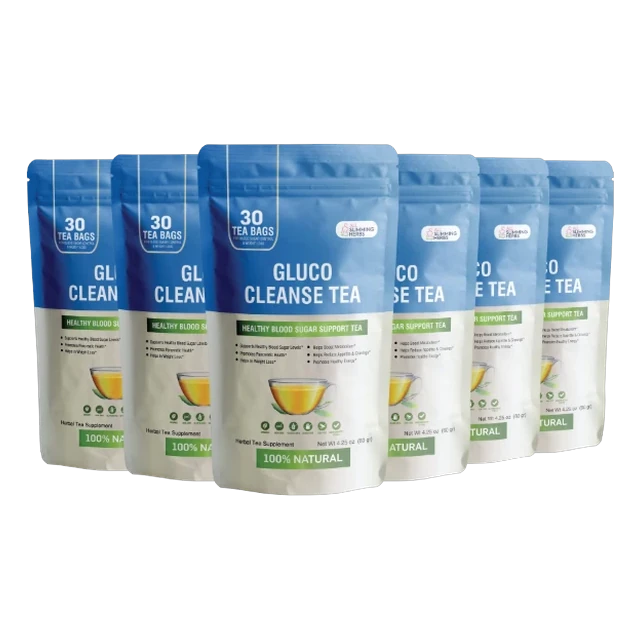
The seller publishes no Supplement Facts panel. So we read the front of the pouch from its product photograph on 29 September 2026. Anyone can open the same image and read the same text.
The pouch prints "30 TEA BAGS" and "Net Wt 4.25 oz (60 gr)". Sixty grams over 30 tea bags is exactly 2 g a bag. Nineteen botanicals and a flavor share that 2 g.
The two printed units disagree, because 4.25 oz is 120 g. A photograph can't tell us which is right, so we use the gram figure as printed.
So one whole tea bag weighs one Cochrane cinnamon dose, before any 19-way split.
Next, the seller's own dose. It says to drink 3 to 4 cups a day. We assume one tea bag makes one cup, since the seller gives no other figure. That's 6 to 8 g of mixed botanical material daily.
To reach 2 g, cinnamon would need to be roughly a quarter to a third of each bag. Eighteen other botanicals and a flavor would share the rest.
Now try an even split. Two grams over 19 botanicals gives about 105 mg each per bag. At three cups that's roughly 316 mg of cinnamon a day.
Allen's meta-analysis covered doses from 120 mg to 6 g a day (PMID 24019277). An even split lands at the very bottom of that range.
The even split is our assumption. The seller states no split at all, so cinnamon could be more or less. Nobody outside the maker can say.
A total weight now exists, but no weight for any single ingredient. The doses aren't necessarily low. They just aren't stated.
We haven't recorded a trial dose for fenugreek or bitter melon. The seller publishes no tea amount to set beside one. The same gap applies.
The testimonials and the numbers
What the page offers in place of a study
The page says "Over 36,781 People Have FIXED Their High Blood Sugar & Are Diabetes Free". It cites 36,781+ reviews and names no review platform. It links no source for either figure.
It also says "as many of our clients shed up to 21 pounds in a month". No study is cited for that.
Five testimonials are printed, each labeled "Verified Purchase". The page shows no verification method. Its own footer says they "may not reflect the typical purchaser's experience".
Two of the five mention prescribed medicine. One writer says "I am off insulin completely" and that "My doctor put me off Metformin as well". The other says the pills a doctor prescribed didn't help. We report these as the seller's material. We can't verify any of it.
The seller does offer a 60-day money-back guarantee. A refund promise is a fair thing to have. It isn't evidence that the tea works. The price page covers the terms.
Where that leaves Gluco Cleanse Tea
Real plants, unknown amounts
The problem isn't that these herbs do nothing. Fenugreek moved HbA1c by 0.54 points in a 2024 meta-analysis. Bitter melon showed significant reductions the same year.
The problem is that this product won't tell you how much of any herb you're drinking. Then it claims to cure a disease.
The evidence for the plants is real and mixed. The evidence for this product is zero. The doses are unknowable. That's why we score it 1 out of 10 in our full review.
Questions about whether Gluco Cleanse Tea works
Short answers, each traceable to something above
Is there any clinical study of Gluco Cleanse Tea?
No. A search of Europe PMC for the product returned 0 records. The product named in its footer, All Day Slimming Tea, also returned 0.
Can Gluco Cleanse Tea regenerate the pancreas?
The seller says it can. No randomized human trial supports beta-cell regeneration by gymnema. Europe PMC returned 0 records for that search.
Do the ingredients lower blood sugar?
Some plants have real but mixed trial results. Fenugreek lowered HbA1c by 0.54 points in a 2024 meta-analysis. Cochrane found cinnamon's fasting glucose effect inconclusive.
Do the seller's 29 scientific references prove it works?
No. All 29 are general consumer pages about type 2 diabetes. None studies the tea or any ingredient in it.
How much cinnamon is in a cup of the tea?
Nobody outside the maker knows. A whole tea bag weighs 2 g, shared by 19 botanicals. The seller states no split. Our even-split assumption gives about 105 mg.
Read the side effects page for how the tea could interact with diabetes medicine. This page is desk analysis. We read the seller's page and queried Europe PMC on 29 September 2026. We didn't test the product. If a fact changes, tell us through the contact page. We'll correct it with a dated note.
That link goes to the seller's own site. We earn a commission if you buy, at no extra cost to you, and it never changes what we write. Our full review has the score and the verdict.
This page is information, not medical advice. Statements about supplements have not been evaluated by the FDA.