VisiFlora Review: A Daily-Value Eye Multivitamin Sold in the Language of a High-Dose Trial
The ingredients are real and the page is unusually restrained. Then you compare the four amounts it publishes against the trial it leans on.
Checked 8 October 2026. Label and price figures checked 8 October 2026. Every source is named below, so you can repeat each check yourself.
What VisiFlora gets right, and where it falls down
Every line below is checked against the seller's own pages, read 8 October 2026.
In its favour
- No countdown timer and no stock counters.
- Disclosed testimonial names and three distinct testimonials.
- A 22-item reference list and honest disclaimers.
- Correct per-bottle sums, and a two-bottle pack that fits the guarantee.
- A real gut-eye literature and ingredients with research behind them.
- A one-time purchase, and zinc at a dose that needs no copper fix.
Against it
- Vitamin C, vitamin E, zinc and copper sit at the Daily Value, not the trial dose.
- The seller publishes no panel, and 14 ingredients share one unquantified blend.
- The 23% comes from ginkgo alone in 11 healthy people over two days.
- Savings are overstated by $182 and $134, and 120 days of the six-bottle pack sit outside the guarantee.
What we found when we checked VisiFlora
Checked against its own sales page, its own refund policy, and the trial it leans on
VisiFlora is a once-daily eye-health capsule sold through BuyGoods. Packs run from $158 for two bottles to $294 for six. On the panel usaloves.com published, vitamin C, vitamin E, zinc and copper each sit at the Daily Value. The AREDS trial used far more. We score it 3 out of 10. That ties it with Gelatine Sculpt and Trimology, behind only EndoPeak.
We landed on 3 out of 10, checked 8 October 2026. The page earned real credit for restraint. The seller itself publishes one amount, zinc at 11 mg, against 21 named ingredients. The 7 amounts on the usaloves.com panel come from a third party. They earn the seller nothing. The AREDS trial tested far higher doses than the Daily Value amounts VisiFlora lists.
We read the rendered sales page in a browser on 8 October 2026.
We checked the sales page, six help pages and the image folder.
Every study we cite came from a live Europe PMC query.
We opened each answer in a real browser with US settings.
VisiFlora scores 3 out of 10, tied with Gelatine Sculpt and Trimology behind EndoPeak. Packs cost $158 to $294. A panel published by usaloves.com lists four AREDS nutrients, each at exactly the Daily Value. The AREDS trial used far higher doses.
Disclosure: we may earn a commission if you buy through a link on this page. You pay the same price either way. The commission doesn't change our score.
What is VisiFlora, and who actually sells it?
A capsule, a 30-count bottle and a gut-eye pitch
VisiFlora is a capsule. The seller's FAQ says "Just one capsule daily with food. No complicated timing or messy routines."
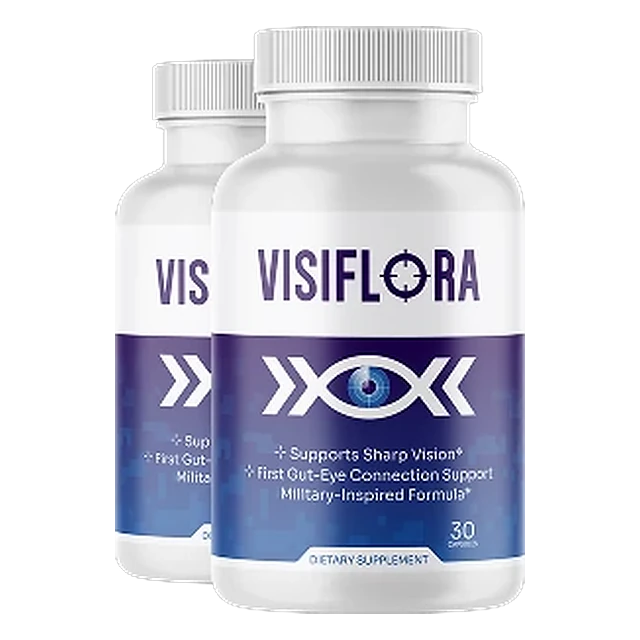
The bottle front reads "30 CAPSULES", so one bottle lasts 30 days. We read that from the seller's own product image at full resolution.
The same image carries three more lines: "Supports Sharp Vision*", "First Gut-Eye Connection Support" and "Military-Inspired Formula*". The sales page adds "22-in-1 vision-essential formula".
BuyGoods is the retailer, with an address in Wilmington, Delaware. Returns go to a warehouse in Aurora, Colorado.
The page says it's "Trusted by former pilots, veterans, and thousands of vision-conscious customers". It also leans on a gut-eye idea. The seller says astaxanthin "Helps Sweep LPS From Your Retina".
We treat those lines as marketing. They aren't evidence about the capsule. Europe PMC returns no record at all for "VisiFlora", so no published study of the finished product exists. The seller doesn't claim one, and Bing says the same.
What does VisiFlora get right?
Ten real credits, and why the score is still only 3
VisiFlora earned its score with real credits. Here are ten, in the order we found them.
Restrained urgency. The page has no countdown timer, no customer counter and no bottles-left counter. It carries one sentence of pressure: "Supplies are limited - and this offer may not return." After Trimology's two frozen counters, that deserves saying.
Testimonial names are disclosed as changed. The seller's footer reads "Names and personal identifying information on this site has been changed to protect the privacy of individuals." That's a real disclosure, and we credit it. It's also why you can't check any of the three testimonials.
The seller adds a results disclaimer too: "No individual result should be seen as typical."
Three different testimonials. Corinne F. of Arizona, James V. of Ohio and Rachel S. of Florida each get their own text. None is duplicated. Trimology's page showed one paragraph twice.
A 22-item reference list. The page at /help/references is headed "Is VisiFlora backed by SCIENCE?" and answers yes in capital letters. It lists 22 sources. Most sales pages in this category publish none. Three of the 22 are commercial pages rather than research. That's worth knowing and nothing more.
The per-bottle sums are right. We multiplied each bottle price by the bottle count. All three packs add up. The two-bottle pack's $40 saving is stated correctly too.
| Per bottle | Our sum | Page total | |
|---|---|---|---|
| 2 bottles | $79 | 2 x 79 = $158 | $158 |
| 3 bottles | $59 | 3 x 59 = $177 | $177 |
| 6 bottles | $49 | 6 x 49 = $294 | $294 |
The two-bottle pack matches the guarantee. Two bottles hold 60 capsules, taken one a day. The guarantee runs 60 days. Buy the starter pack, follow the instructions, and you're covered for the whole course.
The gut-eye premise is real science. A 2026 paper explored endotoxemia in macular degeneration, glaucoma and diabetic retinopathy (PMID 42560008). Another describes the gut-retina axis (PMID 42713337). The seller didn't invent the idea.
No invented ingredients. Saffron has a randomized trial in age-related macular degeneration. Astaxanthin has one in digital eye strain. Lutein and zeaxanthin were tested in AREDS2. These are real substances with real research. Eyebright is the thin one, and we cover it below.
No subscription trap. The seller answers "Are there recurring charges?" with "Never. This is a one-time purchase - no subscriptions, no hidden fees." We haven't placed an order, so we can't confirm billing. The plain statement still deserves credit.
Zinc at 11 mg sidesteps a known problem. AREDS paired 80 mg of zinc with 2 mg of copper. At 11 mg, the zinc-copper depletion concern behind that copper doesn't arise in the same way. That's a point in the product's favor, and it falls straight out of the dose comparison.
Next, what holds the score down.
The claims that carry weight, and the research behind each
Twenty-one named, one amount printed, and a claim for most
The page claims 22 ingredients and names 21. It sorts them into four groups, including a "Vision Defense Matrix" and a "Gut-Eye Barrier Complex". The only amount printed anywhere on it is "ZINC (11MG)".
Here are the claims that carry weight. The quotes are the seller's words, not ours. The research is what we found in Europe PMC on 8 October 2026.
Seller: "A NASA-Researched Antioxidant 6,000x Stronger Than Vitamin C". We found no source for "6,000x" or for "NASA-researched". That's an empty search, not a verdict. A 2025 trial (PMID 40014233) studied 64 children with screen strain.
Seller: "Used Traditionally In Japan To Reinforce The Blood-Retinal Barrier". That's a claim about tradition, offered without a trial. The page prints no amount for any of the three.
Seller: "Shown To Reduce LPS Production And Support Hydration In Retinal Cells". Taurine is concentrated in retinal tissue. We found no human trial of oral taurine lowering LPS or improving vision in healthy adults. Treat it as mechanism, not outcome.
Seller: "Help Improve Blood Flow To The Retina By 23%". The 23% is real and traced to a 1999 study of ginkgo alone. Coleus forskohlii wasn't in it. The full comparison is below.
Seller: "Used For Over 2,000 Years To Support Healthy Optic Nerve Function". Europe PMC returned 279 records. We found no randomized human trial of oral eyebright for any vision outcome. The closest on-topic record is a history paper (PMID 37667609). A claim about tradition is doing the work of a claim about effect.
Seller: "Used By WWII Pilots For Clearer Night Vision And Retinal Strength". A systematic review of the trials is less kind. We set it out in its own section below.
Seller: "Clinically Shown To Help Support Visual Acuity And Eye Health". A real trial exists (PMID 30343354). It gave 100 adults with mild or moderate AMD 20 mg a day for three months. Acuity improved 0.69 of a letter, and the authors say saffron "modestly improved visual function".
Seller: "Natural 'Internal Sunglasses' That Filter Harmful Blue Light And UV Rays". AREDS2 used 10 mg and 2 mg (PMID 23644932). Its primary analysis found "no statistically significant reduction" in progression to advanced AMD. The panel gives no amounts.
A trial result belongs to the dose the trial used. This seller won't say what dose is in the capsule. Our ingredients page takes all 21 in turn.
How do VisiFlora's doses compare with AREDS?
Four nutrients with amounts, each at the Daily Value, and a trial that used far more
This is where the review turns. It's a comparison you can repeat yourself.
The AREDS trial (PMID 11594942) is the study this whole category leans on. The seller's reference list cites the NEI's AREDS page as its twelfth source.
The paper's own title calls it a trial of "high-dose supplementation". It enrolled 3,640 people aged 55 to 80 and followed them for 6.3 years on average.
High dose was the hypothesis. The table sets the AREDS daily doses beside VisiFlora's amounts.
| Nutrient | AREDS daily dose | VisiFlora per capsule | % Daily Value on that panel |
|---|---|---|---|
| Vitamin C | 500 mg | 90 mg | 100% |
| Vitamin E | 400 IU | 15 mg | 100% |
| Zinc | 80 mg | 11 mg | 100% |
| Copper | 2 mg | 0.9 mg | 100% |
| Beta carotene | 15 mg | Vitamin A, 450 mcg RAE, as beta carotene | 50% |
| Lutein | 10 mg (AREDS2) | Inside the 351 mg blend, no amount | Not listed |
| Zeaxanthin | 2 mg (AREDS2) | Inside the 351 mg blend, no amount | Not listed |
Four AREDS nutrients have an amount on that panel. Vitamin C, vitamin E, zinc and copper each sit at exactly 100% of the Daily Value. The beta carotene shows up only as vitamin A, at 50%.
AREDS used amounts far above the Daily Value on purpose. A product built on Daily Values is a different product from the one the trial tested.
Share of the AREDS daily dose in one VisiFlora capsule
Bars show each amount on the usaloves.com panel as a share of the AREDS dose. A shorter bar sits further under the trial.
AREDS doses come from the trial paper, PMID 11594942. The seller publishes no panel of its own.
So VisiFlora is a daily-value eye multivitamin. That's a reasonable thing to be. The trouble is the language around it. The seller cites a trial that tested something else, on a page that publishes one dose.
Now the other half, because it's true and it protects us from overstating. Lutein at 10 mg and zeaxanthin at 2 mg would fit inside a 351 mg blend. Together they'd take 12 mg of it, about 3.4%.
The panel usaloves.com published doesn't say whether they're there. We can't say they aren't, and we won't imply it.
The pattern is still odd. The four amounts on the panel all sit well under their AREDS doses. The two amounts that could match AREDS2 are the two without a number. We won't guess at a reason. You'd be taking the seller's word.
Who published VisiFlora's Supplement Facts panel?
The seller shows no Supplement Facts panel, and a competitor does
VisiFlora's seller publishes no Supplement Facts panel. We checked the sales page and all six help pages. We also tried the obvious file names on the seller's image server, in four extensions. Every one returned a 404 error.
The product render on the page shows the front of the bottle only. The back isn't shown anywhere we looked.
A panel does exist in public. usaloves.com published one on a page titled "VisiFlora Ingredients 2026: Full Label, 351 mg Blend & AREDS2". They state they were supplied the current panel and checked it on 29 July 2026.
It's the only published copy we located. We treat it as a third-party transcription. Every amount in this review, except the seller's own zinc figure, comes from it.
usaloves.com also reached the ingredient count before we did, and in more detail. The page claims "22-in-1". The panel names 21: seven nutrients with amounts plus 14 inside a blend. The blend heading isn't an ingredient. We agree with their count. It isn't our discovery.
Their panel also lists selenium at 20 mcg and chromium at 15 mcg. Neither is part of the AREDS formula.
Fourteen ingredients share one 351 mg proprietary blend with no individual amounts. The blend lists taurine, ginkgo leaf, eyebright, grape seed extract, Coleus forskohlii root and alpha lipoic acid first. Rutin, quercetin, bilberry fruit extract, saffron stigmas extract and lycopene follow. Lutein from marigold, zeaxanthin and astaxanthin come last in label order.
The other ingredients are hypromellose for the capsule, rice flour, magnesium stearate and silicon dioxide. The panel names the distributor as PhytoThrive Labs of Aurora, Colorado 80011. That's the same town and ZIP as the returns warehouse on the seller's refund page.
Where did the 23% blood flow figure come from?
The number is real. Everything around it has changed
Under ginkgo and Coleus forskohlii, the page says they "Help Improve Blood Flow To The Retina By 23%, Enhancing Nutrient Delivery And Visual Sharpness". It gives no author, journal, year or identifier.
We found the source in Europe PMC. It's PMID 10385132, a 1999 paper in the Journal of Ocular Pharmacology and Therapeutics. Its title is "Ginkgo biloba extract increases ocular blood flow velocity".
The 23% is correctly transcribed. The study did find a 23% change. The table sets the claim beside the study, line by line.
| The page says | The study measured |
|---|---|
| Blood flow to the retina | End-diastolic velocity in the ophthalmic artery, a vessel upstream of the eye |
| Ginkgo and Coleus forskohlii | Ginkgo alone. Coleus forskohlii wasn't in the study |
| 23% | 23%, from 6.5 to 7.7 cm/sec, p 0.023 |
| Nothing stated | 11 healthy volunteers, average age 34 |
| Nothing stated | Two days of treatment |
| One capsule a day, ginkgo amount not published | 120 mg a day, as three 40 mg doses |
| "Enhancing Nutrient Delivery And Visual Sharpness" | No vision outcome measured at all |
The authors reported no change in blood pressure, heart rate or eye pressure. They concluded the extract "deserves further investigation".
None of this makes the number false. It makes the sentence around it a different claim. Our does it work page goes through the other trials.
Beta carotene, and who the page sells to
A real AREDS2 finding, and a dose that keeps it in proportion
AREDS2 (PMID 23644932) enrolled 4,203 people aged 50 to 85 with large drusen. Its authors noted more lung cancers in the beta carotene group, 23 (2.0%) against 11 (0.9%). Most were in former smokers.
They concluded that lutein and zeaxanthin "could be an appropriate carotenoid substitute" in the AREDS formula.
On the panel usaloves.com published, VisiFlora's vitamin A is beta carotene. We state the dose in the same breath. The lung cancer signal came from AREDS's 15 mg daily dose. VisiFlora's whole vitamin A entry is 450 micrograms RAE.
That's a far smaller amount, and the signal can't simply be carried over to it.
The fair point is narrower. The page sells to "former pilots, veterans, and thousands of vision-conscious customers". It never mentions smoking once. Its reference list cites the NEI's AREDS page while including the carotenoid AREDS2 concluded should be replaced.
If you smoke, or used to, raise any beta carotene supplement with a clinician first.
Bilberry and the wartime pilots
The better the trial, the less it found
The seller says bilberry was "Used By WWII Pilots For Clearer Night Vision And Retinal Strength". Three of its 22 references cover bilberry and pilots' night vision.
We looked at the research instead. A 2004 systematic review (PMID 14711439) found 30 trials with outcomes relevant to vision in reduced light. Twelve were placebo-controlled.
Its authors write: "The 4 most recent trials were all randomized controlled trials (RCTs) and were negative in outcome." They also note that negative outcomes went with more rigorous methods.
Eleven of the twelve tested healthy people with normal or above-average eyesight. That's who buys a general eye capsule.
The authors don't close the door entirely. They say the weaker evidence "may warrant further trials" in people whose night vision is already impaired. We have no way to test the wartime story, so we leave it as the seller's.
VisiFlora's bilberry amount sits inside the 351 mg blend, unpublished.
What the gut-eye idea can carry
Real mechanism research, and no human trial of the capsule
The gut-retina axis is an active field. Endotoxin is LPS, so the seller's talk of LPS has a real literature behind it. A 2026 systematic review looked at probiotics in vision science (PMID 42614605).
We found no human trial showing that these 21 ingredients lower LPS or improve vision. The mechanism is being studied. The product is being sold.
One more detail, from the usaloves.com panel. It lists no probiotic organism, no strain, no CFU count and no named prebiotic. A gut-eye product with none of those on its panel is worth a plain sentence.
Where Bing's answers go wrong
An AI answer built on misspelled copies of the brand
Many readers meet VisiFlora through Bing's AI answers first, so we checked them. We read each one in a real browser with US settings on 8 October 2026.
Bing's answer for "VisiFlora ingredients" is headed "Full Ingredient List (All 22 Components)". Every line in it is attributed to a misspelled or reseller copy of the brand. The seller's own site is tryvisiflora.com. Not one citation points there.
The domains include visi-floraa.com, visoiflora.com, visiflaora.com and en-visifllora.com. Others are en-en-visiflora.com, en-visiflora.co and visioflora.com. Two are reseller subdomains, visiflora.buynusa.com and visiflora.deliverycaviar.com.
The pages share a template. One says "all 22 VisiFlora ingredients" and another says "all 5 VisiFlora ingredients" in the same sentence. Two others show an identical 5/5 rating on 18.5K reviews.
Bing's own "all 22" list names 21 substances. A press release indexed in Bing News 12 hours before our capture says "21 listed ingredients". That matches the panel.
| Bing says | What the evidence shows |
|---|---|
| "manufactured in FDA-registered, GMP-certified facilities in the USA" | The seller claims USDA National Organic Program handling in a certified facility. It never claims FDA registration or GMP certification. |
| "a legitimate dietary supplement with transparent ingredients" | Fourteen of 21 actives share one 351 mg blend with no amounts. Bing's answer elsewhere says exact doses "are not disclosed". |
| "VisiFlora contains 22 ingredients" | Bing's own list names 21, and so does the panel. |
| "has not undergone clinical trials" | Right. Europe PMC holds no record of the finished product. |
The first claim appears in Bing's answers for "does VisiFlora work" and "is VisiFlora a scam". USDA organic handling isn't FDA registration, and it isn't GMP certification. Bing has upgraded the claim.
Bing gets other things right. It says the blend format means doses aren't disclosed. It says it's "not a replacement for medical treatment of serious eye conditions". It flags ginkgo for people on blood thinners.
We correct Bing in the seller's favor too. Bing mentions "high-dose vitamin E". On the usaloves.com panel, VisiFlora holds 15 mg, which is 100% of the Daily Value. That isn't a high dose. Ginkgo is a separate matter, because its amount is unpublished.
Bing also repeats the seller's 22 and then lists 21. That's the same gap as on the seller's own page.
VisiFlora on Amazon isn't this product
Same name, different brands, no guarantee from this seller
The seller says: "VisiFlora is ONLY available on this page. You won't find it in stores or on third-party sites."
That's accurate about the seller's own product. It's also exactly why the Amazon results are something else.
We searched Bing for "VisiFlora amazon" on 8 October 2026. It returned at least four Amazon listings under that name. One is "VisiFlora Capsules, Official VisiFlora Health Supplement Pills". Another is "GREENVIFY VisiFlora Max Eye Health Supplement", at 60 capsules. A third is "VIDAPLEXTRA Visi-Flora Vision Capsules".
Those are different brands with different capsule counts, and one calls itself Official. If you buy "VisiFlora" on Amazon, you aren't buying the product reviewed here. This seller's guarantee doesn't cover you.
Two savings figures that don't add up
The cheapest pack is the only one stated correctly
Every order card strikes through $99 a bottle. We multiplied that list price by the bottle count and compared the result with the seller's stated saving.
| List price | You pay | Real saving | Page says | Overstated by | |
|---|---|---|---|---|---|
| 2 bottles | $198 | $158 | $40 | $40 | Correct |
| 3 bottles | $297 | $177 | $120 | $302 | $182 |
| 6 bottles | $594 | $294 | $300 | $434 | $134 |
Adding the $214 of bonuses to either real saving doesn't reproduce the stated figure. The two inflated numbers are wrong by different amounts, so no single addition explains both.
The bonus total itself is honest. The page says "VALUE OVER $200", and the three stated values, $97, $67 and $50, add to $214. All three are digital downloads.
One related search deserves an answer. People look for "visiflora 80% off". The deepest discount on the page is $99 down to $49 on the six-bottle pack. That's 50.5% off, and no 80% appears anywhere on it.
"Free US Shipping" is United States only
Four of the five destinations pay $19.95 on every pack
The Advanced and Ultimate cards say "Free US Shipping". The Starter card says "+ small shipping fee". The seller's shipping page puts that fee at $9.95 in the mainland United States.
Outside the United States, the fee is $19.95 on every pack. That covers Canada, the UK and Ireland, Australia and New Zealand. It includes the two packs labeled free.
| Days of product | United States | Canada, UK and Ireland, Australia, New Zealand | |
|---|---|---|---|
| Starter, 2 bottles | 60 | $167.95 | $177.95 |
| Advanced, 3 bottles | 90 | $177 | $196.95 |
| Ultimate, 6 bottles | 180 | $294 | $313.95 |
In the United States, that's $2.80, $1.97 and $1.63 a day. Elsewhere the starter pack costs $2.97 a day and the six-bottle pack costs $1.74.
Delivery takes 5 to 8 business days in the mainland United States and 12 to 20 elsewhere. The refund clock runs from the day you receive the order.
What does the 60-day guarantee fine print say?
Three clauses the sales page leaves out
The sales page says: "No risk, 60-Day Money Back Guarantee. Try VisiFlora for 60 days. If you're not completely satisfied, just return the bottles and we'll refund your purchase. Simple and hassle-free."
The refund policy page says more. Three clauses matter.
First: "We accept returns of all items within 60 days of receiving them for a full refund minus any shipping fees." A US starter buyer loses $9.95. A buyer elsewhere loses $19.95.
Second: "To get a refund, you should send ALL the items you received back to our warehouse". Every bottle goes back, empty or not, to Aurora, Colorado.
Third: "Please keep in mind that we do not support the return shipping costs." Six bottles posted from Australia or the UK is a real cost against a $294 refund.
Then there's the length of the course. At one capsule a day, bottle counts and guarantee days don't line up.
| Days of product | Guarantee | Days uncovered | |
|---|---|---|---|
| Starter, 2 bottles | 60 | 60 | 0 |
| Advanced, 3 bottles | 90 | 60 | 30 |
| Ultimate, 6 bottles | 180 | 60 | 120 |
The page pushes the six-bottle pack hardest. Two thirds of that course falls outside the refund window. The two-bottle pack matches it exactly. We haven't requested a refund. Our complaints page covers the process in more detail.
How much does VisiFlora cost?
Three packs, correct per-bottle sums, and a guarantee that fits the smallest
We read the three order blocks on 8 October 2026. Prices are in US dollars and apply to the United States.
Per-day figures divide each total, plus US shipping where charged, by the days at one capsule a day. We may earn a commission on these buttons. Every pack also carries three free ebooks.
The starter pack is the only one where the guarantee covers every day of the course. It costs the most a day. The six-bottle pack is cheapest a day, and two thirds of it sits outside the refund window.
Two formulas that print every amount
What disclosure costs, priced the same day
We priced two eye formulas on Walmart.com on 8 October 2026. Both publish a full panel and both are taken two a day. PreserVision AREDS 2 is the formula the trial tested.
| VisiFlora, 6 bottles | VisiFlora, 2 bottles | PreserVision AREDS 2 | Equate Advanced Eye Health Complex | |
|---|---|---|---|---|
| Price | $294 | $167.95 with US shipping | $34.47 | $24.92 |
| Size | 6 bottles of 30 capsules | 2 bottles of 30 capsules | 120 softgels | 140 minigels |
| Taken a day | 1 capsule | 1 capsule | 2 softgels | 2 minigels |
| Days | 180 | 60 | 60 | 70 |
| Cost a day | $1.63 | $2.80 | $0.57 | $0.36 |
| Panel published by the seller | None | None | Published | Published |
| Ingredients in the formula | 21 named | 21 named | 6 | 6 |
PreserVision costs about a third of VisiFlora's cheapest rate. Walmart sells the Equate formula as a comparison to the PreserVision AREDS 2 minigel formula. Equate costs about a fifth.
This isn't a recommendation. VisiFlora is a different product, and it adds botanicals such as ginkgo, saffron and bilberry. The comparison doesn't price those. It does show what a published panel looks like.
If an eye doctor prescribed an AREDS2 formula, follow that advice instead of swapping in VisiFlora.
Where it falls short, and what's fair to say
Four real drawbacks, and the credits that hold up
Each AREDS nutrient with an amount sits at the Daily Value. AREDS used far more.
A competitor published the panel. Fourteen of 21 ingredients share an unquantified 351 mg blend.
Ginkgo alone, 11 healthy people, two days, an artery upstream of the eye. No vision outcome.
Two savings figures are overstated. Shipping isn't refunded. Return postage is yours.
Where it falls short
- Vitamin C, vitamin E, zinc and copper sit at the Daily Value, not the trial dose.
- The seller publishes no panel, and 14 ingredients share one unquantified blend.
- The 23% comes from ginkgo alone in 11 healthy people over two days.
- Savings are overstated by $182 and $134, and 120 days of the six-bottle pack sit outside the guarantee.
What's in its favor
- No countdown timer and no stock counters.
- Disclosed testimonial names and three distinct testimonials.
- A 22-item reference list and honest disclaimers.
- Correct per-bottle sums, and a two-bottle pack that fits the guarantee.
- A real gut-eye literature and ingredients with research behind them.
- A one-time purchase, and zinc at a dose that needs no copper fix.
Who should buy VisiFlora, and who should skip it?
A quick way to sort yourself into one list or the other
It might suit you if you want a daily-value eye multivitamin with botanicals added. You'd also need to be happy taking the seller's word on the blend. The two-bottle pack is the one the guarantee covers in full.
Skip it if you've been told to take an AREDS2 formula. Skip it if you want amounts you can check.
Our side effects page sets out each question in more detail.
How did we check VisiFlora?
Five checks, in the order we ran them
Open the sales page in a browser. Read the order blocks, FAQ and footer.
Search the page, the help pages and the image folder for a Supplement Facts panel.
Search Europe PMC for the product, each ingredient and each figure the page uses.
Multiply each saving, add each shipping fee and divide by the days.
Open Bing as a US searcher and check each answer against the page.
Why did we score VisiFlora 3 out of 10?
Behind only EndoPeak on our site, and what holds it back
Ten credits lifted it. They are the restrained urgency, the disclosed testimonial names, three distinct testimonials and a 22-item reference list.
They also include correct sums, a guarantee that fits the two-bottle pack and real gut-eye science. The last three are ingredients with research behind them, a plain no-subscription statement and a sensible zinc dose.
Disclosure holds the score down most. The seller itself publishes one amount, zinc at 11 mg, against 21 named ingredients. It prints no panel. A panel on usaloves.com, not the seller, shows amounts for 7 of the 21. The other 14 sit in one blend with no individual amounts. Those 7 earn the seller nothing.
Dosing costs points too. The amounts on that third-party panel are Daily Value levels, not trial doses.
Smaller marks add up as well. The page claims 22 ingredients and names 21. "Free US Shipping" is US only.
The sales page says "Simple and hassle-free", and the refund policy doesn't match. The 60 days run from receipt, but the bottles must come back. The six-bottle pack leaves 120 days outside the guarantee.
Two of the three stated savings don't follow from the seller's own $99 list price. That costs the page its honesty point.
Beta carotene deserves a clinician's view if you smoke. Bilberry's best trials were negative. Eyebright rests on tradition. We found no source for "6,000x" or "NASA-researched".
We've scored the others on the same scale, all out of 10. EndoPeak gets 5. Gelatine Sculpt and Trimology get 3, the same as VisiFlora. SugarReset gets 2. AlphaFuel Pro, CelluCare and Gluco Cleanse Tea get 1. Only EndoPeak scores higher than VisiFlora.
VisiFlora's page is restrained, its per-bottle sums hold and the product is a reasonable thing to be.
A score near the middle isn't an endorsement. It can't climb while the seller publishes one amount and the page borrows a trial's language.
Four changes would lift it. Publish the panel. State the lutein, zeaxanthin and ginkgo amounts. Fix the two savings figures. Match the guarantee to the pack lengths.
Questions buyers ask before they order
Short answers, each traceable to something on this page
What is VisiFlora?
A once-daily eye-health capsule sold on tryvisiflora.com through BuyGoods. The seller claims 22 ingredients and names 21.
How much does VisiFlora cost?
Two bottles cost $158, three cost $177 and six cost $294. The starter pack adds $9.95 shipping in the US. Elsewhere, every pack adds $19.95.
Is VisiFlora the AREDS formula?
No. On the panel usaloves.com published, vitamin C, vitamin E, zinc and copper each sit at the Daily Value. AREDS used far higher doses.
Has VisiFlora been clinically tested?
We found no published study of the finished product. Its ingredients have research, but the seller publishes no amounts for most of them.
Where does the 23% blood flow claim come from?
From a 1999 study of ginkgo alone in 11 healthy volunteers over two days. It measured blood velocity in the ophthalmic artery, under PMID 10385132.
Is the money-back guarantee real?
It runs 60 days, and the refund excludes shipping fees. You send every bottle back at your own cost to a warehouse in Aurora, Colorado.
Is VisiFlora on Amazon the same product?
No. The seller says it sells only on its own page. Amazon listings under that name come from other brands and carry no guarantee from this seller.
Is VisiFlora safe to take?
Ginkgo and vitamin E raise bleeding questions with blood thinners or surgery. Ask a pharmacist first if you take medication. Sudden vision changes need a doctor the same day.
How we reviewed this
- Read the rendered sales page in a browser on 8 October 2026, order blocks and footer included.
- Read the seller's references, shipping and refund pages the same day.
- Searched for a Supplement Facts panel on the seller's site. Found none, then found one published by usaloves.com and checked by them on 29 July 2026.
- Queried Europe PMC live for the product and each ingredient, and traced the 23% to its source.
- Read the Bing answers a US searcher sees, and priced two comparison formulas on Walmart.com.
- We didn't buy the product or request a refund. We haven't seen a physical label. This is desk research, with no invented customer stories.
If a price or policy has changed since 8 October 2026, tell us through the contact page. We'll add a dated correction.
That link goes to the seller's own site. We earn a commission if you buy, at no extra cost to you, and it never changes what we write. Our full review has the score and the verdict.
This page is information, not medical advice. Statements about supplements have not been evaluated by the FDA.